Championing Inclusion, Faith, and Human Rights
The European Forum of LGBTI+ Christian Groups is a pan-European network working to create a more inclusive and affirming space for LGBTI+ people within Christian communities.
Our Journey
In 1982, Émile Letertre, a French Catholic priest and member of the LGBTI+ Christian group David & Jonathan, envisioned a space where LGBTI+ Christians across Europe could unite. He invited friends from England, Italy, Belgium, and the Netherlands to meet in Paris. Sixteen individuals responded, leading to the first annual meeting in Strasbourg in 1983. This gathering marked the birth of the European Forum of LGBTI+ Christian Groups - a community rooted in solidarity, faith, and the pursuit of inclusion.
Who We Are
The European Forum is an ecumenical network comprising over 40 member groups from more than 20 European countries. We are united by a shared commitment to achieving equality and inclusion for LGBTI+ individuals within and through Christian churches and other religious bodies.

Through decades of dedication, the European Forum has grown from a small gathering into a vibrant network championing the rights and inclusion of LGBTI+ Christians across Europe. We continue to build bridges between faith and identity, fostering communities where all are welcomed and affirmed.
Our Work
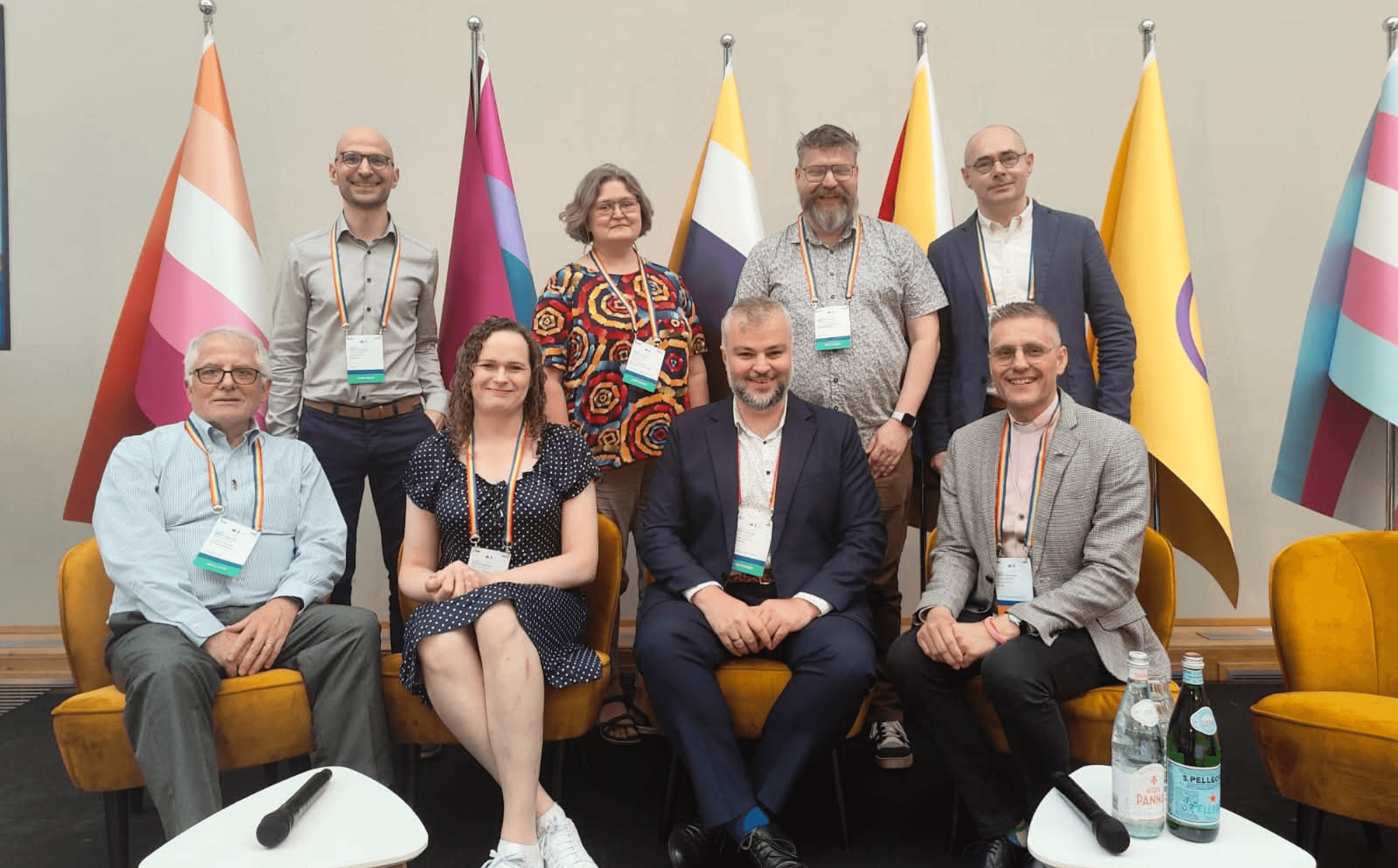
Each year, around Ascension Day, we host an annual conference in a different European country. These gatherings offer opportunities for worship, workshops, and community building. They also serve as a platform for our Annual General Meeting, where member groups collaborate on our collective direction.
Beyond conferences, we engage in advocacy, support emerging groups, and maintain high-level contacts with organizations like the Conference of European Churches (CEC) and the World Council of Churches (WCC).
Our Positions
We actively work towards greater equality and inclusion through church politics. Our positional statements articulate our stances on pertinent subjects and urgent issues. These statements guide our advocacy and inform our member groups.
Gender Equality
Historically and to the present day, European society and churches have been strongly based in a binary construction of gender, supporting a (sense of) hierarchy in which “males” are considered superior. This has caused structural oppression, discrimination, and violence victimising all people that do not identify with the traditional male gender. A growing number of churches have opened their offices to different genders, but still men continue to be dominant in many leadership positions, whereas other genders mostly form the vast majority that practically uphold local churches and church affiliated organisations.
The European Forum of LGBTI+ Christian Groups believes the Eternal has created all people equally, both in Their image and likeness (Genesis 1:26). Baptised in Christ, there is “neither male nor female”. All people are equal as followers of Christ (Galatians 3:26–28). It is therefore that the European Forum is committed to working to achieve gender equality, women’s rights, and sexual and reproductive rights. Combatting the patriarchal systems of oppression and harmful gender norms and stereotypes and upholding the principle of self-determination and bodily integrity and autonomy are at the heart of the convictions of the European Forum. The European Forum supports and recommends the ratification of the Istanbul Convention in all European countries and appeals to churches to end gender inequality in all offices and in all professional and voluntary positions and to advocate the deconstruction of patriarchal systems of oppression, to combat harmful gender norms and stereotypes, and to acknowledge the principle of self-determination, bodily integrity, and autonomy for all.
The European Forum of LGBTI+ Christian Groups believes the Eternal has created all people equally, both in Their image and likeness (Genesis 1:26). Baptised in Christ, there is “neither male nor female”. All people are equal as followers of Christ (Galatians 3:26–28). It is therefore that the European Forum is committed to working to achieve gender equality, women’s rights, and sexual and reproductive rights. Combatting the patriarchal systems of oppression and harmful gender norms and stereotypes and upholding the principle of self-determination and bodily integrity and autonomy are at the heart of the convictions of the European Forum. The European Forum supports and recommends the ratification of the Istanbul Convention in all European countries and appeals to churches to end gender inequality in all offices and in all professional and voluntary positions and to advocate the deconstruction of patriarchal systems of oppression, to combat harmful gender norms and stereotypes, and to acknowledge the principle of self-determination, bodily integrity, and autonomy for all.
Conversion Practices
Conversion practices are all practices that seek to suppress, change or divert the (a)sexual orientation and/or gender identity of a person. These practices are often religious in nature—through the form of prayer, reading of Scripture, and sometimes even physical contact. They also can be medical, psychiatric, psychological, and cultural. There is a lot of evidence to suggest that so-called “conversion practices” are without the presupposed effect. The harm they nevertheless inflict on those subjected to them is long-lasting, such as spiritual harm, depression, anxiety, attempts to suicide, self-hatred etc. Sometimes, even suicide is the tragic result. Conversion practices are still legal in most countries. Only a few implemented a full legal ban and protection for those vulnerable to these practices.
The European Forum of LGBTI+ Christian Groups believes the Eternal has created all people in Their image and likeness (Genesis 1:26), regardless of their (a)sexual orientation, gender identity, or gender expression. There is therefore no reason to change, heal, adjust, control, or convert anyone’s (a)sexual orientation or gender identity to align with heterosexual and cisgender norms by so-called “conversion practices” or “reparative therapy”. These are violent and dangerous.
The European Forum appeals to churches and other faith communities urgently to refrain from all practices that try to change an individual’s (a)sexual orientation, gender identity, or gender expression as specified above and to denounce all these practices. The European Forum appeals to churches, other faith communities, and governments to protect people of all ages against any form of malpractice, to therefore forbid all “conversion practices” and to support LGBTI+ people to embrace their (a)sexual orientation, gender identity, and gender expression as God given.
Marriage Equality and Same-Sex Blessing
In a growing number of European countries, civil union has been opened to also include same-sex partners. A few churches so far have decided positively on blessing partners in a same-sex union. In some European countries, civil unions can be also concluded by church officials (on church premises); at the same time blessing of same-sex unions is still impossible there.
Some European countries have defined civil union constitutionally as a union before the law of one man and one woman or are politically paving the way to do so, making it impossible to open civil union also for partners of the same sex. In these countries, (mainstream) churches often actively engage in banning the possibility of opening civil unions for partners of the same sex, claiming the exclusive sanctity of heterosexual union in marriage on a Biblical basis and appealing to the supposed danger for the “traditional family”, curtailing the right to freedom of religion and the right to a specific cultural identity.
(For an overview of countries’ and chruches’ status, see the Rainbow Europe Map and Index and the Rainbow Index of Churches in Europe, respectively.)
The European Forum of LGBTI+ Christian Groups considers that the right to freedom of religion and the right to cultural identity cannot and should not dictate the legal definition of family and family unions, including civil union. We believe that civil union should include all families based on love, mutuality, care, and respect, without discrimination based on sexual orientation or gender identity. It should include equality for all people, governed by law.
In the opinion of the European Forum, it is not possible to distinguish any Biblical basis in favour of the exclusive position of heterosexual union in marriage, as historically this union is a modern invention not known in Biblical times. The nuclear family as such, which has been promoted by churches and cultures as the ideal in modern times, does not exist in the Bible nor is it advocated as an exclusive expression of being Christian.
The European Forum calls on governments to open civil union for all families, to legally protect them, and to make the social recognition of all families their priority. The European Forum calls on all churches to underline the sanctity of all families based on love, mutuality, care, and respect and to realise the possibility of blessing families and partners in civil union.
Hate Speech
Illegal hate speech is defined in EU law as ‘the public incitement to violence or hatred on the basis of certain characteristics, including race, colour, religion, descent and national or ethnic origin’. While the EU Framework Decision on combatting racism and xenophobia covers only racist and xenophobic speech, the majority of Member States have extended their national laws to include other grounds such as sexual orientation, gender identity and disability.
Churches and other faith communities are protected by the Freedom of Religion and Belief, which allows teachings and convictions that may be of a discriminatory nature, as is often the case stating opinions on the position of lgbtiqa+ people. As such these teachings and convictions do not match the definition of hate speech. However, when speaking in public, church and religious leaders sometimes scapegoat LGBTI+ individuals, maybe inadvertently, legitimising harmful words and actions from their followers that marginalise, ostracise, and demonise these communities, potentially leading to violence.
The European Forum believes that there is no room for hate speech in whatever form, in society in general nor in churches and other faith communities. Instead, the European Forum believes that any public debate and debate within churches and other faith communities is always to be governed by the good will to share opinions reflecting a godly character, responsibly, decently and in a considerate manner, however critical these may be (inspired by Mat. 7,1-5, Rom. 14,13, Eph. 4,31-32, Phil. 2,3-4, Col. 3,12-14). Churches and faith communities must consistently cultivate respectful and constructive discourse. (Eph. 4,29, Prov. 18,21).
The European Forum appeals to the authorities to implement sound anti-discrimination and awareness raising policies and encourages churches and other faith communities to appeal to the authorities to do so. The European Forum encourages churches and other faith communities to participate in public campaigns that condemn hate speech and to create a narrative that avoids language that might incite their staff and members to speak and act violently about LGBTI+ people. The European Forum furthermore encourages churches and other faith communities to develop and respect codes of conduct reflecting principles of equality (better than equality principles) and to educate their staff and members about matters of sexual orientation, gender identity and sex characteristics.
As an organisation that strongly defends religious freedom and freedom of expression at the intersection with other fundamental rights, we believe these must be exercised responsibly. Neither freedom of expression nor religion can be invoked to legitimise or incite discrimination, hostility, or violence against LGBTI+ people, communities, or organisations.
Traditional and Family Values
In many countries, mainly in Central and Eastern Europe and Central Asia, “traditional values” are used by governments as political tools to introduce censorship into society and to limit the right to free expression and association for LGBTI+ people. Equal rights for LGBTI+ people are perceived as not in line with these “traditional values”. The introduction of the ”gay propaganda“ in Russia (2013, expanded in 2022) that underlines the importance of “traditional values” (e.g.”family values”) has the effect of intimidating and censoring the media and restricting public protests and demonstrations in which sexual orientation, gender identity and gender expression are considered components of personal and group identity. Similar laws have been passed in Hungary in 2021 and in Georgia in 2024, arriving at an absolute low point with banning Prides altogether in Hungary in 2025. Churches in the aforementioned countries either have remained silent or have spoken up in favour of adopting convictions and laws that find their basis in traditional values” (e.g.”family values”).
The European Forum acknowledges that traditions, as well as numerous religious, cultural and social norms and practices are part of culture, which are constantly changing and evolving. Traditional values cannot be isolated and separated from developments in society and in the churches that over time change the meaning of values. Among other things they are affected by feelings, emotional desires, mutual support and solidarity with those marginalised in our societies.
The European Forum is committed to protecting and expanding LGBTI+ rights as a moral and spiritual duty for defending the universality and indivisibility of human rights over against the universal claim of “traditional values”.
The European Forum embraces “family values” such as love, mutual care and responsibility, respect and sharing possessions and property as values for all those that have chosen to live together in a household or in small communities, regardless of their composition. The European Forum denies that the “nucleus family” represents a biblical or Christian understanding of family. Families in the Bible show great diversity. The Gospel does not deny the value of family that is created through a biological bond, but its value is surpassed by the family that is the Christian community. In Christian tradition people are first and foremost siblings in Christ (Marc 3,31-35).
The European Forum calls on governments, churches and other faith communities to resist adopting “traditional values” and “family values” that are exclusive, as fundamental for policy and convictions. It further calls on governments, churches and other faith communities to prevent and take action against attacks on the LGBTI+ community on the basis of these values and to engage in ensuring equality and inclusion for all.
The Rights of Transgender People
Gender diversity has always been an integral part of the human experience. Transgender, non-binary, and gender non-conforming people have existed throughout history, alongside cisgender women and men. Yet, many churches today deny gender diversity as a natural aspect of human existence, instead attributing it to ideological indoctrination or even evil forces. This denial of the diversity of humanity has serious and harmful consequences. In many European and Central Asian countries, the notion of “gender ideology” – a term that originated in the Roman Catholic Church – is being used to develop legislation that discriminates against gender diverse people or even completely denies their existence.
The European Forum affirms the inherent dignity of all transgender, non-binary, and gender non-conforming people. We believe that human diversity is a reflection of God’s creativity and should be celebrated in churches and other faith communities. We affirm that God calls each person to life (Isaiah 49:1) and continues to call us to life again and again (Deuteronomy 30:19-20), so that we may experience life in abundance (John 10:10).
The European Forum deeply regrets the role that some churches and Christian organisations and individuals play in the public harassment of gender diverse persons, whether through theology, policy, or discourse. The European Forum regrets transgender people are made to despair, when, as the Psalmist declares, they are “fearfully and wonderfully made” (Psalm 139:14).
The European Forum calls upon the legislative authorities to develop legislation that bans conversion practices for gender diverse people, that prevents restricting access to appropriate health care and to counter stigmatising non normative gender expressions by raising awareness through public campaigns.
The European Forum calls upon all Christians and churches and other faith organisations to embrace and affirm gender diverse people by acknowledging their humanity, recognising their relationship with the divine, and honoring their ability to share their experiences. The European Forum strongly encourages churches and other faith communities to raise awareness about gender diversity among its staff and members and to actively protest against discriminatory laws and policies that erase the humanity of transgender people.
LGBTI+ Refugees
The number of refugees worldwide is increasing as a result of political persecution, armed conflicts, and climate change. In addition to the challenges all refugees are facing, LGBTI+ refugees encounter specific and compounded difficulties. These include the lack of adequate awareness and training among public officials regarding LGBTI+ issues, the absence of safety in refugee camps, and limited access to healthcare, particularly for transgender people. In some European countries, detention centres for migrants (often resembling prisons) exacerbates the vulnerability of LGBTI+ individuals, exposing them to isolation, fear and heightened risk of abuse. However, being a refugee is not a crime.
The European Forum strongly condemns all forms of violence, harassment, and degrading treatment directed at migrants and refugees, be it in the countries of their origin, along migration routes or within host societies. The European Forum believes that all of us are called to protect and support refugees and asylum seekers, including those who are LGBTI+ (Deuteronomy 10:19; Matthew 25:35).
The European Forum calls on all relevant authorities to fully implement their obligations under international law and agreements (e.g. the Reception Conditions Directive). This includes the timely identification and effective support of applicants with special reception needs as well as addressing the specific vulnerabilities of LGBTI+ people when shaping national asylum systems. The European Forum further calls for active cooperation with specialised non-governmental organisations. It insists that all refugees, among them LGBTI+ refugees, must be provided with safe living conditions, timely and appropriate healthcare, and effective protection from persecution.
The Forum calls on all relevant authorities to guarantee that asylum procedures are fair, transparent, and robust. Safeguards that ensure integrity in asylum procedures are essential, not only for maintaining public trust but especially for protecting those whose lives genuinely depend on international protection. The European Forum therefore supports assessment practices that are professional, trauma-informed, and evidence-based, ensuring that accommodations are provided according to demonstrated needs and upholding the principles of truth and justice.
The European Forum also calls on churches across Europe to respond with compassion and courage by actively supporting LGBTI+ migrants and refugees. They are called to offer practical assistance, safe spaces, and spiritual care. The European Forum encourages churches to support and stand in solidarity with communities and organisations that are already engaged in this work. They should recognise the vital role of these bodies in witnessing to justice, dignity and love for all people.
Inclusivity and equality
Historically and to the present day, European society and churches at large have discriminated against people with a non-heterosexual orientation, people who are gender non-conforming and people who are intersex. This was and is based on a heteronormative, binary and patriarchal understanding of human relations as well as the organization of society and church. This has, passively and actively, led to the exclusion of many.
Scientific progress has given more insight into the diversity of sexual orientation and gender identity. Nurtured by the human rights movement after the Second World War, concern for equality for all people, also regardless of their sexual orientation, gender identity or expression or sexual characteristics, has grown considerably. Changing societal attitude towards more acceptance, mainly in the Western part of Europe, has gradually resulted in a greater visibility of non-heterosexual, gender or sex non-conforming people. In some countries, this has resulted in anti-discrimination laws and programmes supporting equal opportunities and treatment of all people. Some churches have pioneered in or followed those developments by welcoming non-heterosexual, gender or sex non-conforming people. This has included opening the offices, the sacraments as well as other rituals and practices to them. This however can still only be said of a small number of churches.sc
The European Forum of LGBTI+ Christian Groups believes that the Eternal has created all people equally, both in Their image and likeness (Genesis 1:26). Baptised in Christ there is no reason to discriminate on the basis of ethnicity, economic position, disabilities, sex, gender, gender identity or expression. All people are equal as followers of Christ (Galatians 3:26-28) and are to be included into the community of the church, acknowledging their own role as a part of the body of Christ (1 Corinthians 12).
This is why the European Forum is committed to achieving equality for all in society and in churches. Criticising the system of patriarchy (understood as historically shaped forms of social organization that emerged in earlier contexts but no longer serve the flourishing and equal participation of all people in contemporary society) and harmful gender norms and stereotypes as well as upholding the principle of self-determination and bodily integrity and autonomy are at the heart of the convictions of the European Forum’s convictions.
The European Forum therefore appeals to all relevant political authorities to (further) develop anti-discrimination laws and programmes supporting equal opportunities and treatment of all people. The European Forum appeals to churches:
• to examine their inclusivity on the basis of institutional equality and nondiscrimination, practices, language and speech and public policy,
• to reflect theologically and ethically, engaging in dialogue with contemporary scholarship, including scientific insight and pastoral experience,
• to end inequality in all offices and in all professional and voluntary positions,
• to grant full access and participation in sacraments and other institutionalized rituals and practices,
• to advocate the deconstruction of patriarchal systems,
• to combat harmful gender and heteronormative stereotypes,
• to actively reach out to the most marginalised in our communities in society at large and
• to work with key partners such as human rights organisations, queer organisations, trade unions, women’s organisations, organisations for refugees and immigrants and governmental bodies to ensure safe and equal access to services as well as educational, housing, healthcare, employment and income opportunities.
Our Mission
We strive to:
Defend the right of LGBTI+ people to freedom of religion and belief.
Champion human rights and uphold the dignity of every individual.
Encourage open, positive dialogue on sexuality within Christian traditions.